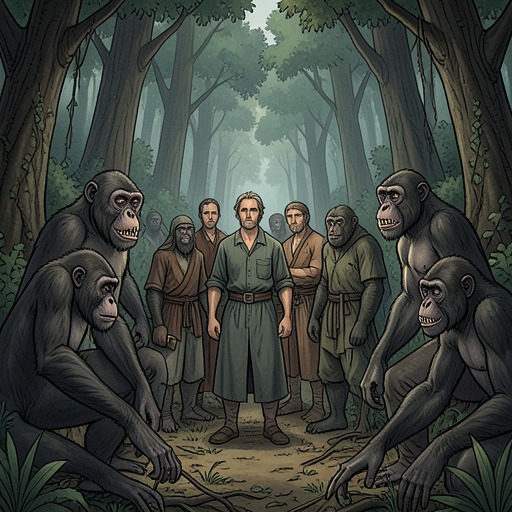
African Tree-Dwelling Apes
Last and First MenThe African Tree-Dwelling Apes were the only terrestrial species described as having evolved far enough to compete with humans in practical versatility. They could organize coordinated resistance, use tools and weapons, and outwit the Second Men within a limited sphere. Yet their ingenuity did not develop into broad self-criticism: traditional cravings and a fixation on metal eventually helped bring about their own destruction. Their history is a sharp counterpoint to the Second Men’s greater capacity to recover from disaster and resume a larger civilizational project.
Encounter with the Second Men
The Second Men encountered the apes while a small group of pioneers crossed into an African forest region in search of metals brought near the surface by volcanic activity. At first, the visitors understood the resistance as a serious practical obstacle. The apes used primitive bows and poisoned arrows, and their coordination in warfare marked them out from other animals the Second Men had encountered. They also protected the local Sub-men: when the human party advanced, the apes rounded up groups of them and drove them beyond the invaders’ reach.
The encounter quickly revealed that the apes’ social world included both toolmaking and the organization of labor. They kept the Sub-men as domesticated workers and used them to carry timber for a settlement made from woven branches, apparently still under construction. The apes maintained their authority not only through weapons but through intimidation, including the use of juice from a rare aromatic plant that made the Sub-men docile. The Second Men, by contrast, had come for a metallurgical survey and initially regarded the apes with more amusement than hostility.
That first encounter turned abruptly violent. The apes gathered in the treetops in large numbers and killed the pioneer party with their arrows; one man escaped into Asia. He returned two years later with a much larger force, but the Second Men did not make the expedition a punitive campaign. They established themselves near the forest, communicated and traded with the apes, and eventually gained permission to enter the territory and continue their survey. The peaceful arrangement did not erase the deeper conflict between the communities; it gave their contrasting values room to become more visible.
Ingenuity, custom, and metal
The apes could be quicker than the Second Men at solving immediate problems, especially problems involving the satisfaction of appetite. Their ability was nevertheless sharply bounded. They lacked self-criticism and accumulated inherited customs that could be harmful as well as fanciful. The Second Men could be momentarily outwitted, but the account presents them as more capable over time because they could act with greater breadth and sounder judgment.
Metal exposed this difference. The Second Men sought it as a resource for an already developed civilization. The apes had no comparable practical use for it, but the bright ingots became symbols of power and status. They first demanded a share of the metal in exchange for allowing the human survey to proceed. Once they had acquired it, they hoarded it: standing among them came to depend on carrying an ingot, and the metal became part of the community’s conventions of respectability. Material that might have served practical ends instead became an object of display and an increasingly powerful traditional craving.
As their hoards grew, disputes over possession shed the earlier appearance of orderly exchange. The apes then began to oppose the export of metal from their land, and some proposed turning it into more effective weapons with which to expel the invaders. That proposal was rejected for two related reasons: they lacked the ability to work the crude metal, and they considered using it for any service beneath its sacred status. The decision captures the species’ central contradiction. They could recognize metal as a possible source of power while remaining unable to treat it as a material to be transformed and put to use.
Conflict over the Sub-men
The apes’ treatment of the Sub-men became another point of conflict with the Second Men. The apes imposed harsh labor and humiliating ordeals on their dependents, whose responses they did not understand. The Second Men protested, but the protest made no sense to the apes: they assumed that beings they regarded as cattle existed to serve those they considered superior. They interpreted the visitors’ objections not as a criticism of their treatment but as evidence that the humans lacked an appreciation for the fantastic.
This was not simply a disagreement over policy. The apes could be kind and generous to one another, yet they were unable to extend the same understanding to those they had placed beneath themselves. Their narrow perspective made others’ distress difficult for them to recognize, while their customs allowed the subordination of the Sub-men to seem natural. The Second Men’s intervention therefore confronted a hierarchy that the apes considered self-evident, adding to the friction already created by the human presence and the struggle over metal.
Disease, reversal, and extinction
The apes turned that conflict into a calculated attack by exploiting a vulnerability they had learned about in the Second Men. The humans were susceptible to diseases associated with the Sub-men, and only rigorous quarantine had previously contained an outbreak. A particular nut, palatable to both apes and humans, was already being traded for additional metal. The apes deliberately infected quantities of the nuts with diseases found among undomesticated Sub-men, then allowed shipments to travel into Asia with the human caravans.
The consequences were catastrophic for the Second Men. The pioneering settlements were wiped out, and much of the species died; the remaining human civilization broke apart, leaving scattered, diseased survivors. The Sub-men, already adapted to the diseases, were not similarly undone. The apes had used their knowledge of the human weakness to remove the immediate intrusion, but their action did not establish a lasting victory over the Second Men. Within centuries, the human species had recovered from infection and begun moving toward civilization again.
When the Second Men crossed the mountains into Africa once more, about a thousand years later, they met no resistance. The apes’ intelligence had disappeared, and their metal fixation had become fatal: burdened physically by their accumulated metal and mentally by its obsession, they had been overthrown by the Sub-men and devoured by their former dependents. The species that had once organized an effective military response to human pioneers thus vanished through the consequences of its own narrow customs and the hierarchy it had imposed. Its rise and fall make ingenuity alone an inadequate measure of survival: the apes could devise a devastating tactic, but could not adapt their social and material habits before those habits became their undoing.